
• Skip to primary navigation
  • Skip to main content
  • Skip to primary sidebar

Locum Tenens Guy

Make the most of your locum tenens work!

  • ❓ New to locums? START HERE
  • 😎 Top Pay Rates
  • 💡 Coaching
  • 📚 Resources
    • 🧾 Tax help
    • Ask questions or leave comments!
    • Locum Tenens Companies Reviews
    • Salary Calculator
    • State Profiles
      • Locum tenens in California
      • Locum tenens in Florida
      • Locum tenens in Hawaii
      • Locum tenens in North Carolina
    • Tax Calculator
You are here: Home / Archives for insurance

insurance

An (Almost) Unbiased Look at the Hospitalist Lifestyle: Employed vs Locum Tenens

July 16, 2021 by LocumTenensGuy

lifestyle
authors portrait

Vlad Dzhashi, MD

FREE REPORT: Locum Hospitalist Pay by Region

Lots of people ask me why I am doing what I’m doing. I mean, why don’t I get a “regular” hospitalist job?

Is locum tenens really that good? Or is it just because I have a short attention span or a personality problem of some sort?

The short answer is: lifestyle!

My hospitalist lifestyle underwent a big transformation over the years as I transitioned from being a resident to a full-time employee to the locum guy.

Today, I’ll show you exactly why I made this transition, and then I’ll compare two lifestyles: permanent hospitalist and locum hospitalist.

I have to warn you, I am super biased and favor locum tenens 100%.

Having said that, if you find any outrageous lies here or you disagree with something, feel free to throw “rotten tomatoes” at me in the comments section.

Without further ado, let’s look at the “pillars” of the hospitalist lifestyle:

  • Schedule
  • Money
  • Spare time
  • Burn out
  • Career path

Hospitalist lifestyle: key pillars

Without further ado, let’s look at the “pillars” of the hospitalist lifestyle:

  • Schedule
  • Money
  • Spare time
  • Burn out
  • Career path
Are you looking for a locums job?

My agency offers the Highest Pay Rates in the Industry

Learn More

Hospitalist schedule

Permanent job:

As a full-time hospitalist, you’ve got your typical 7-on/7-off schedule and its variations, e.g. 5 on/5 off or 10 on/10 off. On average, hospitalist jobs offer 11 days a year of PTO time on top of that; although, more than 50% of hospitalists do not get any PTO at all.

So we are looking at 170 shifts a year. At first glance, it looks like you work less than half a year.

Doesn’t sound like much work, does it?

When I started my first hospitalist job after residency, it felt like a dream job to me. I was truly enjoying a hospitalist lifestyle.

Of course!!!

For somebody used to working 80 hours every week during the residency, switching to 80 hours every other week was a great deal!

The best thing about the permanent hospitalist schedule is that it’s predictable: you know you are there for 7 days and then again for 7 days after a one-week break.

Predictable Schedule

However, there are problems with this “fixed” schedule:

1 – Sooner or later your shifts will fall on holidays, weekends and other days that you really need to be off (e.g. kid’s birthday, anniversary, other important events that you want to attend, etc.)

2 – You will have to rotate through nights and swing shifts (everybody has to take a turn kind of a thing). It makes a hospitalist lifestyle messy, especially if you cannot stand the nights, like me.

3 – Your vacation time (the majority of hospitalists DO NOT have any PTO time) is at your administration’s mercy. The typical rule is to apply early or else you are stuck. The problem I found was that most of my peers wanted to take time off around the same times I did in winter and summer.

4 – You only get 7 days off in a row. But what if you want to be off for a couple of weeks or a month or two? The good old, “Let’s swap some shifts” doesn’t always work well, as you probably know.

Now, there are programs that are trying to create a very flexible schedule, and some even offer a few weeks of PTO. Unfortunately, they tend to pay less and you still won’t have much control over your schedule.

Locum tenens:

Here, your schedule is determined by you.

There are lots of possible options: you can find locum gigs with a 7-on/7-off schedule or you can create a M-Th or M-F schedule, as I’ve seen hospitalists with school-age kids do.

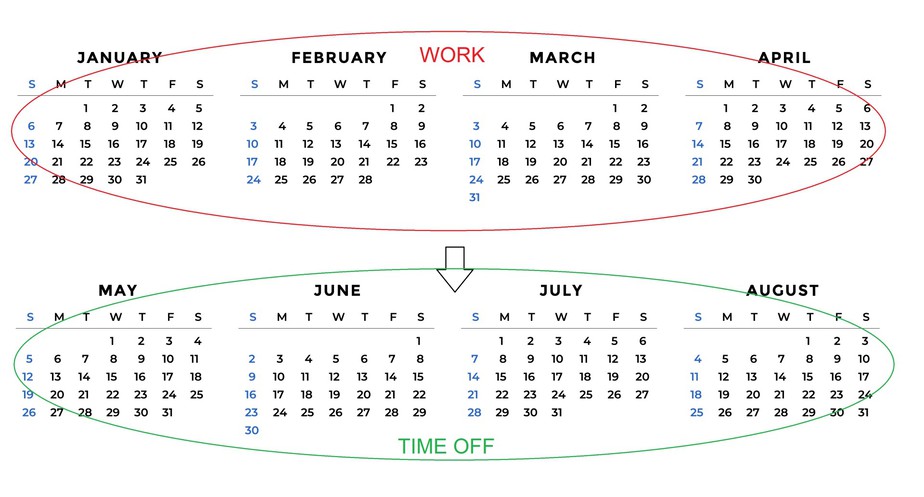
The way I’ve created my schedule this year is I’ve decided to work around 160 shifts. (My thought was it would give me a good income and leave plenty of time off.) Then, I distributed them throughout the year around the school break time. It looks like this:

My locum hospitalist schedule this year, great hospitalist lifestyle
My locum tenens schedule

As you see, my spring and fall months are busiest for me: I work 20 shifts a month. But I am COMPLETELY off two summer months a year, and I make up for it by working longer stretches for a few months.

What changed in my schedule and lifestyle compared to my previous 7-on/7-off job?

1 – I travel for a full 2 months every summer with my family without asking anybody’s permission.

2 – I’ve got a very “light” schedule during Jan and Feb. This way, I stay away from the flu season months, since they are always FREAKING BUSY.

3 – I don’t work any night shifts since I typically need lots of time to recover after them.

The beauty of the locum tenens is that my schedule is completely customized to my needs and plans.

Now, I have to admit, it doesn’t always work the way I plan. A couple of times my shifts were canceled on short notice and I had to scramble for work at a different hospital.

I also once had no work for 8 weeks in a row, which didn’t bother me much because of the “safety net” I got, including my locum tenens health insurance. I ended up making up for those by adding a few shifts a month throughout the rest of the year.

What I am trying to say is that my locum schedule is not perfect, but it’s always very good. That’s because I have the maximum possible control over it!

Hospitalist spare time

Now, let’s look at the time when you are off.

A full-time hospitalist job gives you very predictable time off and a good amount of it. Although you still essentially work an average of 40 hours a week (84 hours every other week), it sure feels good when you are off.

Rambo thumbs up

However, you are limited in what you can do with your spare time because you’ve got only 7 days off.

Is this enough time off?

Actually…NO!!!

You see, the life was not created for people working 7 on/7 off. Let me explain.

Personally, I am convinced we all need to free up some time every year to learn something new or experience the things we’ve always dreamed about.

In fact, I’ve made it my rule and have followed it for a few years now. Every time it gives me a new perspective and mental energy boost for months to come.

For example, a couple of years ago, I did a month-long point-of-care ultrasound training at the University of California Irvine.

Let me tell you, I had a blast!

I learned so much in just a few weeks!

The great thing is that I was off for a month in Irvine, CA, for my training, went back to work for several weeks and then traveled for another month and a half with my family.

All of this would’ve been impossible if I had a 7-on/7-off schedule.

Let’s look at learning Spanish, for example, which is another important skill in “my bucket list.”

Wouldn’t it be nice to speak Spanish so that you could communicate with your patients without needing an interpreter?

Of course!!!

Now, with the flexibility of locum, you could take a couple of months off (or even more than that) as a traveling doctor and go to Spain or Latin America, plunge into the culture and language, and I bet you would learn it really fast!

Could you master Spanish as fast when you work a full-time, permanent job?

Not really!

Believe me, I’ve tried to learn a foreign language before: you schedule few lessons a week with a tutor, read and listen to some podcasts, but your progress is painfully slow. Shortly after you’ve started, you feel stuck and give up.

These are just examples of the experiences and skills you can jumpstart when you’re privileged to have a flexible schedule.

Since I’ve switched to locum tenens, I’ve had so many more options for what to do with my spare time. I’m convinced my life became much richer with those experiences.

Travel:

What if you want to take a really exciting trip?

If you are considering any “serious” or long-term travel, locum is the way to go.

With the 7-on/7-off schedule, you can make some local trips in your week off. But anytime you change more than a few time zones, you need a long time to recover and 7 days off is clearly not enough.

What if you need to visit your relatives abroad?

I know a lot of hospitalists whose families live abroad, and they travel to visit them every year. In fact, some chose locum tenens just to be able to visit for a month or two at a time.

The ugly side of locum tenens time off:

Enough about good stuff! Let’s talk about the “annoying part” of being a locum hospitalist.

One thing that is different from any permanent job:

YOU HAVE TO HUSTLE!

What do I mean by that?

1 – I always need to make sure I’ve got enough shifts scheduled for at least 4-5 months ahead. So I am on the lookout for new locum or per-diem gigs and probing my current hospitals to see how long they would need my services.

2 – I have to get credentialed at new hospitals as well as get new state locum tenens licenses, so I fill out lots of paperwork.

3 – When I work out of state, I spend at least 6-8 hours just to get to and from the hospital location. This could be much worse if I ever decide to fly coast to coast or want to do a long drive to the neighboring state.

Five hospital badges
Five hospital badges: it took 5 applications to complete as well as a few state licenses, multiple emails, and many phone calls to get credentialed at all these hospitals.

Doesn’t sound very exciting, does it?

Now, listen, I still think locum is totally worth it! You have to hustle, but you gain so much freedom. It’s just the price you pay for that freedom.

Plus, I’ve learned to be efficient and found very helpful resources. So at this point, I probably spend no more than a couple of hours a month on the “housekeeping” issues.


  • Jumpstart your Locums Career!
  • Sign up for my coaching to access:
  • Top Gigs
  • Top Pay
  • Unique resources
  • No stress
Learn more
  • Jumpstart your Locums Career!
  • Sign up for my coaching to access:
  • Top Gigs
  • Top Pay
  • Unique resources
  • No stress
Learn more

Hospitalist income

Everybody would agree that money is important for your lifestyle. It may not be as much about what you can buy with it, but more about how much freedom you have.

Now, I’ve written in detail about the locum tenens hospitalist salary. I’ve also created this locum tenens salary calculator to help you calculate your salary.

If you want to know how much locum hospitalists get paid in different regions, check out the special report I’ve created. Click Here to download it.

Simply put, as a locum tenens hospitalist, you get much higher hourly pay, which makes it a better use of your time.

To prove this, let’s take a look at the permanent and locum income more closely using a timeline.

The “regular hospitalist,” aka “Mr. 7 on/7 off,” makes a mean hourly pay rate of $123/hr and the average “locum Joe” makes $160/hr.

Let’s see how long it will take both of them to make $1M:

Locum vs Permanent, number of shifts needed to make $1M

So it will take 160 shifts less for the “locum Joe” to make his $1M.

Congratulation “Mr. 7 on/7 off”! You’ve worked a whole year for free to get the same results.

Roughly speaking, every 3 years of locum income equal 4 years of the full-time hospitalist salary.

Do you like working for free?

I sure don’t!

Another amazing thing about locum tenens is that you can easily switch to a higher paying gig anytime. With the permanent job, once you’ve signed the contract, you get what you get.

The point is that none of the top full-time hospitalist salaries can beat the locum tenens income.

You might say, “That’s nice, but I don’t want to make more money. The average hospitalist salary will do.”

No problem!

You can work less and still have a great income.

How about only 9 shifts a month?

hold on a minute, hospitalist lifestyle

Exactly!

Here’s how to do it:

Simply pick a locum gig in a state with zero or low income tax, negotiate like a pro, and get your 50% $/hr more.

This way you can work 30-40% less time. So instead of 170 shifts a year, you will only need to work 110 shifts a year, or 9 shifts a month.

Onward

Are hospitalists happy? Beware the burnout

The burnout sneaks up on you when you’ve got too much long-term stress at work, and it starts affecting your functioning at the mental and physical levels.

The truth is that you can burn out as a hospitalist pretty easily if you ignore the stressors. If it happens, it’s important to take a step back and try to understand what makes you unhappy at work.

Burnout
http://aheartandheart.tumblr.com/

Can you burn out working locum tenens?

Yes, absolutely!

I experienced it myself when I worked too much for too long at a hospital with a very toxic culture. When I realized what happened, I canceled my shifts for the whole month and rearranged my schedule to work only at the hospitals where I enjoyed working.

Now, could I have done that so easily if I was a full-time hospitalist?

Not really!

Last time I checked, hospitalists don’t get a standard “burnout” leave unless it’s time for your vacation.

With locum tenens, you simply have so much more control of where and when to work that you can avoid the burnout in the first place and address it right away if it ever rears its ugly head.

Hospitalist career

The biggest advantage of being a permanent hospitalist is that you can easily transition to an administration role: e.g., hospitalist director, CMO, quality and safety etc.

On the other hand, if you see your career path outside of hospital medicine or medicine in general, locum is better.

The flexibility of the locum tenens schedule lets you explore and experience new things. Who knows, you may create an actual career out of it.

Your hospitalist career path may have no path at all — you are a locum hospitalist and then you retire.

If you are interested in the early retirement and financial independence, locum can be a shortcut.

After all, your schedule could be 15 years on/45 years off.

Locum bonus: no meetings or committees.

Who likes the hospitalist team meetings, raise your hand!

Falling asleep at the boring meeting

The truth is….NOBODY!

I always felt they were the biggest time wasters. You know, a dozen or more hospitalists gathered in the room, talking about all the grown-up stuff — productivity, billing, he said/she said BS.

The best part of the meetings was when actual patient care and workflow were discussed. However, I always felt that you could get away with a simple email or two instead of a super formal gathering.

Now, the reason I mention this is that….it’s completely missing in the locum tenens world. For good.

Locum lets you out of the seemingly endless array of meetings and hospital committees.

And that’s great! I’ve got better things to do with my life.

The best hospitalist lifestyle:

Hospital medicine is a great specialty for a balanced lifestyle.

Locum tenens, however, allows you to crystallize it.

Since I switched to the locum tenens, I’ve gotten to design my hospitalist lifestyle the way I want: I work less, make more money, and never miss out on any exciting life experiences.

New to locum tenens? Check out my complete guide for newbies in 2021!

Filed Under: insurance

Locum Tenens Contract: How to read the agreement in one minute or less

July 16, 2021 by LocumTenensGuy

written agreement pages
authors portrait

Vlad Dzhashi, MD

Today, I am going to teach you how to glance at and make sense of the locum tenens agreement in less than a minute.

You may be thinking: I’ve got better things to do with my life than reading “stupid” contracts.

Wrong!

The truth is that you ALWAYS have to look at the contract. Medicine is a risky business, so you want to cover all your bases!

Now, this post is not going to make you a contract lawyer. Instead, it will give you a perfect recipe on where to look for potential “red flags,” and you’ll learn a simple way to quickly scan locum tenens agreements.

I’ll also give you examples from real-life contracts. This way it’s going to be easy to make sense of the confusing legal jargon. (BTW, you won’t find this info anywhere else on the web!)

I mention another important hack in this post: keywords that you can search within a contract document (typically a pdf file or webpage) and find the exact section you need to review it super fast.

Dog in a lawyer's suite

Disclaimer: I am not a lawyer, and this article is just for self-education purposes. It’s not meant to replace professional advice. Consider getting legal consultation for detailed contract review.

What is a locum contract?

A locum contract is the work agreement between a physician and a locum tenens company or a hospital/clinic. At the core, it’s a contract a physician independent contractors sign with their temporary employers that determines how much they will be paid, contract termination, and other important clauses.

Now, let’s look at all the “moving parts” of the locums agreement in more detail.

Are you looking for a locums job?

My agency offers the Highest Pay Rates in the Industry

Learn More

malpractice insurance

The standard type of malpractice insurance hospitalists get is claims-based, which means you are covered only when both the incident and the claim (when they actually sue for that incident) happen when the policy was active.

Since you may stop working with the locum agency at some point or they could go out of business, it’s important that you get a guaranteed “tail.”

This would extend the locum tenens malpractice coverage for all the incidents, regardless of when the legal claim was made.

How much coverage is enough?

$1M/3M is a standard for hospitalists. The first number ($1 million) is how much is covered for each particular incident. The second number ($3 million) is how much total coverage you get.

The more the better, but anything less – no bueno!

Here are some examples of coverage terms:

1 – “Company shall provide professional liability insurance coverage for each Physician to cover all incidents which may occur during an Assignment, in limits of $1,000,000 per incident and $3,000,000 in the aggregate.”

2 – “Provider will be insured under the terms of “Agency name” group professional liability insurance policy or similar professional liability insurance provided by Client (i.e. hospital).”

3 – “Professional liability insurance will cover Provider, for a medical incident arising out of Provider’s rendering of, or failure to render, professional services while working on an Assignment. Upon expiration of the policy, “Agency name” will purchase group tail coverage or prior acts coverage with the new policy.”

4 – “Company will procure professional liability insurance, including post-termination continuation coverage or tail coverage, as applicable, based on Company’s insurance policy.”

TIPS:

♦ For malpractice coverage, look for $1M/3M.

♦ For claims-made insurance, make sure you get a “tail” coverage.

♦ Keywords for quick “scanning”: malpractice, liability, insurance, tail, coverage, policy.

SHIFT CANCELLATION OR OUT CLAUSE in locum contract

You can typically cancel any shifts 30 days in advance, and the same goes for the hospital you work for.

Here, you need to make a note of the time frame required for termination and how termination is made – written, via phone call, etc.

Here are examples:

1 – “At all times during the Term of this Agreement, this Agreement may be terminated without cause or liability by either party upon thirty (30) days’ prior written notice to the other party.”

2 – “If Physician is not able to fulfill an assignment they have accepted, then Physician will give at least thirty days’ notice.”

The next important thing is to look at what happens when you cancel less than 30 days in advance.

Here you need to avoid the “strict lingo,” e.g:

If you fail to comply…you shall promptly pay to “Agency name” a cancellation fee equal to…”

or

“Provider will be charged for Company’s unrecoverable expenses.”

You should have wiggle room in the contract to get you off the hook if you have a legitimate excuse to cancel your shifts: e.g., illness, family emergency, etc.

Here’s an example of better wording:

Professional may cancel any scheduled placement less than 30 days in advance by giving written notice…if Professional becomes unable by reason of emergency or medical condition to fulfill an agreed placement.”

or

“If Physician becomes incapacitated or otherwise physically unable to perform Services…Physician’s cancellation shall be in writing.”

TIPS:

♦30-day cancellation window is a standard.

♦Avoid “strict” cancellations.

♦You should able to cancel any time in the event of sickness, emergency, etc. Consider adding this to the contract.

♦Keywords for quick “scanning”: cancel, schedule, notice, term.

  • Jumpstart your Locums Career!
  • Sign up for my coaching to access:
  • Top Gigs
  • Top Pay
  • Unique resources
  • No stress
Learn more
  • Jumpstart your Locums Career!
  • Sign up for my coaching to access:
  • Top Gigs
  • Top Pay
  • Unique resources
  • No stress
Learn more

NON-COMPETE CLAUSE in locum tenens contracts

In a nutshell, the non-compete clause in locum tenens contracts doesn’t allow you to work with the hospital through another locum company or directly for a certain period of time.

Here, you have to make sure the term is no longer than 2 years after the official end of the agreement.

Let’s look at one example:

Physician may not solicit or contract with Client or any of its affiliates…for temporary staffing assignment nor accept a permanent position…”

TIPS:

♦The non-compete clause should not be longer than 2 years after contract termination.

♦Keywords for quick “scanning”: non-compete, covenant, clause.

TERMINATION and RENEWAL of locum tenens physician contract

You should be able to terminate the locum tenens agreement any time with a 30-day written notice. It means that you officially “break up” with an agency.

But why would anybody need to do it?

Because if you don’t, it will be auto-renewed. So even if you don’t work with the agency for a while, you are still in a binding relationship with them, including the non-compete clause.

Why is this important?

A few years after my last shift at one local hospital, I decided to pick up some shifts there again. This time I wanted to connect with them directly to have a long-term locum tenens hospitalist gig close to home.

Guess what?

Since I didn’t terminate my contract with an agency that placed me there in the first place, I either had to use them again (which kills the point) or terminate my agreement and wait for 2 years.

Another example: if your agency loses the contract with the hospital, a non-compete clause will not allow you to work at that facility either as a per-diem or through another agency’s services.

In my situation, I ended up terminating my contract and had to wait for the 2-year non-compete clause to expire.

TIPS:

♦Keep in mind that a locum tenens contract is auto-renewed unless you terminate it.

♦Terminating the contract will cancel the “non-compete” clause typically in 2 years.

♦Keywords for quick “scanning”: automatically, renew, terminate.

Sample locum tenens contract template:

If you want to dig a little deeper and actually look at a sample locum tenens contract, you can check out this resource. Although this agreement seems to be much shorter compared to the ones I’ve signed in the past, it has all the important parts in it.

CONCLUSION: reading a locum tenens physician agreement

Now you know the quickest way to scan through the locum tenens agreement.

The good news is that your contract is always negotiable. So if you’ve noticed anything you want to be changed, do not hesitate to reach out and request it.

If you are too lazy to dig through the contract yourself, just ask your agency/hospital to point specifically to the important sections I mentioned.

At the end of the day, it doesn’t matter how you do it. Just do yourself a favor –  ALWAYS review your agreement!

New to locum tenens? Check out my complete guide for newbies!

Filed Under: insurance

Become Traveling Doctor: satisfy your wanderlust

July 13, 2021 by LocumTenensGuy

Traveling doctor
authors portrait

Vlad Dzhashi, MD

Becoming a traveling doctor is a dream for many people!

A lot of physicians and medical students would agree that traveling is one of the best things you can experience in life.

And…it doesn’t even matter if your favorite place is in the US, Europe, or Asia. If you’ve ever caught a “travel bug,” it becomes your passion and your lifestyle.

But…

Here’s a catch 22:

You work and make money = You don’t travel

You travel = You don’t work and don’t make money

Time vs Money Scales

If you work a traditional full-time physician job, this is sad but true.

You see, most medical professionals are stuck with a few weeks of vacation per year. This means they can travel only once a year. 

This may work for some, but if you want to be a traveling doctor (i.e. a real “nomad”), this is simply NOT enough to satisfy your wanderlust…

And even if you are a 7on/7off hospitalist, you have only seven days off at a time to travel. 

The trouble is that any travel outside of the US would mean changing time zones (sometimes 10 or more). So if you travel in seven-day increments, you’ll have to constantly adjust to new clocks.

This sucks!!! 

You will NOT enjoy your trips and you won’t be able to visit a lot of really exciting places.

You may be wondering:

Ok, I gotcha, this makes sense. But I DO want to make much more than average salary AND travel a lot…is this even possible?

YOU BET IT IS!

With locum tenens you can create the schedule that fits your lifestyle: YOU decide HOW MUCH vacation time you want and WHEN you want it.

Not only that, your work time makes you MORE money so you’ll have more cash to spend.

Sounds like a perfect COMBO to become a doctor that travels a lot!

In the next few minutes, you’ll learn exactly how YOU can create a one-of-a-kind vagabond lifestyle without giving up on money.

Let’s jump right in.

Traveling doctor's option #1:

Work locums and travel in “clusters.”

Clusters? What the hell is this?

Clusters are “longish” periods of time ranging from a few weeks to a few months.

 So…for example, you can alternate between a month of working locums and a month off.

Traveling doctor calendar example

Another example could be working for three months (e.g. a lot of hospitalist gigs are 3-4 months long) and taking a couple of months off after that.

Traveling doctor calendar example 2

This way you’ll have more than enough time to travel AND recuperate at home before you kick off with your next stretch.

Personally, I’ve been “clustering” my work in the fall and spring and leaving summer time off so that I can travel when my kids have a school breaks.

My locum tenens schedule

Of course, how much time off you can “afford” will depend on how much you are trying to make.

The lower your desired amount is, the longer your time off could be, and the easier it is to create your “perfect schedule.”

But!

What if you wanna make “effing money” FIRST and travel the world AFTER hitting it big?

The next option is for you…

Traveling doctor's option #2:

Make lump sum and then travel

If you’ve got ambitious plans AND you want to become a traveling physician and see the world without giving up on them, the following approach works like a charm.

What do I mean by “ambitious plans”?

This could be anything from paying off your mortgage or medical school loans, making a large investment, saving money to start your own business, to simply having $ [name your number] in the bank…

Locum tenens gives you control to do that. 

And, if you combine this approach with a frugal lifestyle you’ll end up with lots of cash that you can invest or spend on whatever makes you tick.

The success formula here is rather simple:

  • Come up with your after-tax $ amount.
  • Decide how fast you can possibly make it.
  • Get Board-Certified and receive all the other required certifications
  • Calculate how much time you need to make this happen.
  • Buckle down and work until you’ve got it!

Of course, don’t forget to get board-certified, get good number of state medical licenses and receive all the other required certifications if you’re fresh from training.

Here’s a good example of one of my buddies who is a hospitalist and a hard-core real-estate investor. He’s used this approach to achieve impressive results.

He would schedule his locum’s shifts based on how much cash he needed to buy his next investment property in California, New York or Florida. After he had saved enough, he took time off to regroup before his next big project.

This approach worked extremely well for my friend: he now owns multiple homes in CA and he visited a lot of fun places all over the world in his time off. 

Sounds like a sweet deal to me!

Now, coming up next:

I’m about to show you how you can leverage locum tenens to travel for FREE…

This unique opportunity is available exclusively to the locum tenens docs and it is a great way to visit the most exciting places in America.

Yeah, yeah, yeah. I can hear you thinking: “There’s no FREE lunch…”

Don’t be a naysayer! 

Just read on and you’ll see what I mean…

Locum tenens = free vacation

You see, when you travel to your locum tenens location, your airfare, rental car, and hotel are already paid.

Now…to “convert” your locums trip into a FREE vacation, all you need to do is to leave enough time to check out those local “hot” spots.

For example…

If you’re a hospitalist working 7on/7off or emergency medicine/urgent care doc working block schedule, you can fly in a couple of days early and stay a few days longer after your last shift.

Or…

Instead of returning home during your week off, you can stick around and spend the whole week touring the surroundings.

If you work Monday through Friday on the other hand (e.g. internal medicine doc doing primary care), you can travel on the weekends. To free up even more time for travel, you can negotiate a shorter work week for example Monday through Thursday or even Wednesday)

The point is: there are multiple ways to make it work and become a traveling physician.

And, if you you don’t mind rural areas or underserved areas, you may have even more options!

Thankfully, in the locum tenens “healthcare business,” everything is up for negotiation, including the details of your travel.

Now, you may be thinking…

Ok, Vlad…I’ve got time off, my travel is paid for…but what the hell am I going to do with my time off? How do I actually have FUN?

Don’t you worry, brothers and sisters…

I’ve got you covered!

I am about to show you a way to find countless travel ideas and…

you’ll have an unforgettable experience you’ll remember for the rest of your life.

I bet this will open your eyes!

Bonus: How to spice up your locum tenens life

In the summer of 2018 I was planning my next trip to Napa, California, where I was supposed to do a long stretch of shifts.

While browsing the internet to check the ratings of my hotel, I spotted a “things to do” section. I clicked it and saw a list of DOZENS of travel experiences: tours, trips, outdoor activities, classes, workshops…

At that moment, the LIGHT BULB went off:

Why don’t I treat my locum tenens trip the same way I treat my vacation trip?!

Let me tell ya…this “revelation” MADE A HUGE DIFFERENCE, as my next locum tenens trip turned out to be the best I’ve ever had! 

And…I was also mad at myself for missing out on SO MANY adventures for years!!!

Here’s what you need to turn your next trip into a vacation you’ll enjoy 500%:

1 – Go to tripadvisor.com.

2 – Type your location in the search box.

3 – Click on “things to do.”

4 – Choose the kind of fun you want.

How to find experiences on tripadvisor

Another great source is airbnb.com:

1 – Go to the website and type in your location.

2 – Click on “experiences” or “adventures.”

And the best thing, if you expand your TripAdvisor or Airbnb search to the state level, you can find many more fun things to do in ANY part of the country.

This approach will work perfectly regardless of what your medical specialty is.

Final thoughts:

If traveling is your passion and you are itching to check out the most beautiful and exciting places that exist in the world without giving up on your career, know this…  

Locum tenens is the BEST way to travel, see the world, create perfect work-life balance AND make $!

Period.

New to locum tenens? Check out my complete guide for newbies!

Filed Under: insurance

Locum tenens travel hacks: stay sane while living out of a suitcase

June 6, 2021 by LocumTenensGuy

authors portrait

Vlad Dzhashi, MD

Did you know that I am a “reluctant” locum tenens traveler?

Yes, I’ve traveled a lot, but I’ve always preferred not to do it.

Oddly enough, my reluctance made me look for ways to have a hassle-free travel experience.

So today the time has come for me to share what I’ve learned in 6+ years of driving, flying, and staying at hotels and apartments all over America while working locum tenens.

You will not only learn how to travel with comfort but, most importantly, how to stay in the best mental and physical state despite living out of a suitcase.

If you are working locum tenens now or plan on doing it, you simply CANNOT miss this stuff!

Let’s jump right in…

Table of Contents

TSA precheck

Let’s start with the basics.

If you fly more than a few times a year (most docs working locum tenens docs do), TSA precheck is a MUST.

With the TSA precheck, you can save hours of your precious time at the airport.

You don’t have to wait in lines going through security checkpoints and you’ll have extra time before your flight since you can come to the airport as late as one hour before your flight’s departure.

TSA precheck is a no-brainer: it costs $85 and takes only a couple of weeks to get approved after you’ve submitted your application. 

Onward.

  • TSA precheck is a MUST for a hassle-free airport experience

Comfortable stay

Staying comfortably is the most important part of your travel, and I’ve picked up a few hacks over the years.

👉 How to vet quality hotels

One key lesson I’ve learned is not to rely only on star ratings since some 3-star hotels are no better than motels.

The best way to vet hotels is to look them up on TripAdvisor. I would avoid any hotel that has a rating of less than 4 out of 5. 

Also, check out the “travelers” photo section to get an idea of what to expect.

👉 Step up your game: sweet stay in a suite

When you stay in a suite, you don’t just have more space, you are guaranteed to have a better sleep. 

Think about it: your bed and the hallway are separated by two doors, which removes some of the noise coming in.

So do not hesitate to ask your staffing company to provide you with this “extra,” as the price difference is only about $20-40/night.

In my experience, no locum tenens agency ever refused. But, even if they do, I would pay out of pocket. It will cost about $200-400 for a week but it is totally worth it.

👉 Pick your room like a pro

Not only do you need to stay in a more spacious room, it is a good idea to pick your room’s location. 

Make sure to call the hotel reception a few days in advance and let them know your preferences: you want to stay on the highest floor possible, far away from the elevator and also facing off the road. 

If they cannot satisfy all these requirements, at the very minimum you should avoid the ground floor like the plague: you’ll be annoyed by cars, lights, people talking, etc. 

This makes even more sense if you work night/evening shifts and need to sleep during the day.

Long stay = Airbnb or furnished apartment

Now, if your locum tenens gig is longer than a couple of weeks at a time, I would recommend staying at the “home-like” settings. 

Renting Airbnb or furnished corporate apartments would be better options. Just make sure to read my locum tenens housing post where I show you how to avoid trouble with those.

  • Vet your hotels on the Tripadvisor
  • Stay in a suite
  • Stay on the highest floor possible, ideally as far from the elevator as possible and your room should NOT be facing the road
  • For longstays, Airbnb or furnished apartments will be better options

Packing

Never spend more than 5 minutes getting ready for your travel

Packing my stuff used to be a huge time-waster for me. Over the years, I figured out a way to make it short and sweet.

Here’s a trick: to pack quickly, UNPACK as little as possible after you are back home from your trip.

Basically, the only thing that you remove from your suitcase is your laundry. Everything else should stay THERE e.g., toiletries, gym shoes, utensils, thermos, lab coat, stethoscope, pager, and badge, etc.

This way it will only take you a few minutes to pack your clean clothes and you are good to go.

  • to pack quickly, UNPACK as little as possible

Healthy Food

“Treat your body like a mansion, not a woodshed….”

I don’t need to explain what a difference healthy nutrition can make. Having said that, it’s easier said than done, especially when you are away from home. 

There’s always a temptation to eat hospital cafeteria food: it is easily available and it may even be free. 

The problem is that I am yet to find a hospital where you can find healthy choices.

Here are a few tips that will help you to cook your own meals while traveling as a locums.

Your own kitchen:

First, get a hotel room with a kitchenette. The fact that you’ve got everything you need to cook will leave you with no excuses, and you will be more likely to stay on the “right track” with a healthy diet. 

If no hotel in the area has this amenity, at least make sure your room has a fridge with a freezer.

Take care of groceries FIRST:

Second, swing by the grocery store BEFORE you check in to the hotel. Again, you’ll have no excuses not to cook your own meals.

Instant Pot:

And, finally get this guy on your team:

Instant pot

INSTANT POT! 

The Instant Pot is truly a “magic” machine that costs about 100 bucks, weighs 9 lb (hence it can be easily put in your luggage), and can cook healthy meals in a matter of minutes (this is not an exaggeration!!!).

In fact, it is much quicker than ordering through DoorDash or driving to the restaurant (another excuse not to cook is destroyed).

What do I make in it?

My meals usually consist of 3 components – protein (meat or fish), greens, and a little bit of complex carbs (typically beans, lentils, quinoa, or sweet potatoes). 

That said, this “magic pot” can make great and healthy meals fast no matter what your preferences and dietary restrictions are.

  • Healthy food = food you’ve cooked
  • Get a hotel room with a kitchenette
  • Do grocery shopping before checking in to the hotel
  • Buy the Instant Pot

Dealing with jet lag

You may think that unless you travel from Hawaii to the East Coast, the jet lag would not be a problem.

But, from what I’ve noticed, even one hour difference can mess me up physically and mentally. I simply don’t have as much energy and feel “foggy.” It takes a good two to three days to get over it.

Here are a few tricks that worked well for me and will help you to get up to speed.

First, limit your caffeine to one cup in the morning the day of your flight.

Second, try to work out in the morning before your shift starts. It doesn’t have to be hard or long. Working out for as little as 10-15 minutes is more than enough to get your internal “clocks” on the right track. 

If you don’t feel like doing any exercise, at least take a quick walk outside.

The third is a neat hack that will work like a charm if you are willing to drop $200 on this portable lightpad. 

Aurora Lightpad

This compact lamp generates a very bright light, simulating natural sunlight. You put it at the bedside and turn it on in the morning as soon as you wake up.

I’ve noticed it resets my “clocks” even better in the wintertime when mornings are dark and gloomy.

  • Limit your caffeine the day of your travel
  • Exercise or take a walk in the morning before your first shifts starts
  • Use lightpad in the morning to reset your circadian rhythm

Onward.

Winter driving

Winter driving deserves special mention.

You see, if you ever work in the Northeast, Midwest, or any mountainous areas in the winter, you better be prepared.

Personally, I’ve made a lot of trips across the Washington state’s mountain passes and I know this can be pretty tricky.

Driving in the snow
Driving through the mountain pass: you better be prepared.

The key here is to have a reliable car that would make your driving seamless.

First, your car MUST be an SUV or a truck and it has to be all-wheel drive. You’ll be surprised but some of these cars are front or rear-wheel drive only.

Second, at the very minimum, your rental should have all-season tires, and, ideally, special winter tires, as most rental companies prohibit you from using chains on their cars.

Hertz seems to be the only company that offers a winter tire package, but other agencies may have a few available cars with winter tires as well. The best thing to do is to give them a call and find out.

If you work with a locum tenens company’s travel agent, have them do the calling and double-check for you. 

Now, the staffing agency may push back on your request, as SUVs are usually more expensive to rent. If this happens, tell them you don’t feel safe driving in the snow and explain you may not make it on time for your assignment due to the weather conditions unless you drive an SUV.

And finally, when picking up your rental, make sure to actually look at your tires. You should see one of these signs on your tires.

All-season tire symbol

“Ok” option – “All-season” tires

The best option – proper winter tires.

  • Drive All wheel drive SUV or truck
  • Make sure your car has winter (best option) or all-season (Ok option) tires
  • When picking up your car, look at signs on your tires to double check

Beating“cabin fever”

“Cabin fever” is real! 

Just imagine…you are away from home, from your usual circle of friends and family, your favorite hobbies, activities, sometimes for months and months on end.

Frustrated face cabin fever

No wonder some of the locum tenens docs (myself included) start feeling lonely, isolated, and cut off from the world.

Fortunately, the solution is very simple: you MUST GET OUT of your hotel room and go places.

Just walk outside in the park, hike in the woods and breathe some fresh air, drive around a little bit, or even better…socialize with other docs.

The key is to change the environment and your surroundings when you are off work to keep your “battery” charged and stay sane.

  • The best ways to prevent and beat cabin fever: GET OUT OF YOUR HOTEL, change the scenery, socialize with other people

Wrap up

That’s all I wanted to say for now! Comment below if you’ve got any other helpful tips for locum tenens travelers.

New to locum tenens? Check out my complete guide for newbies!

As featured on

logo_doximity

Filed Under: insurance

Top five best and five worst states to work locum tenens from a liability perspective

May 31, 2021 by LocumTenensGuy

authors portrait

Vlad Dzhashi, MD

In 2018 I was named in a malpractice lawsuit for the first time.

The whole experience was extremely stressful, and since this happened, I started thinking of ways to avoid this mess again in the future.

After doing my research on this topic, the first thing I realized is that a good portion of docs in this country have been sued or will be sued. For example, a 2011 NEJM study showed: “Each year during the study period, 7.4% of all physicians had a malpractice claim.”

The other revelation was that not every state is created equal and there are parts of the country that are literally a “hot mess” when it comes to liability and others are as close to “legal paradise” as they can get.

In fact, you are more than 10 times (!!!) likely to be sued in the “riskiest” state compared to the lowest risk state.

That’s why I’ve decided to collect data and present you the best and the worst states from a liability perspective.

I hope this will help you to choose which states to avoid and which states to look at more closely, whether you work locums or full-time jobs. 

👉 Without further ado….let’s announce the “winners”:

Best five states with the lowest malpractice risk:

  • #1 Best: North Dakota
Flag of ND

North Dakota had the lowest rate of malpractice claims against physicians. The state implemented a tort reform by limiting noneconomic damages to $500K. 

On top of that, if noneconomic damages exceed $250K, the law requires additional review and approval.

  • #2 Best: Wisconsin
Flag of WI

The state of Wisconsin has the second-lowest rate of malpractice claims. It has the cap on noneconomic damages of $750K and also has the state-wide Patient Compensation Fund that would pay for damages exceeding the cap.

  • #3 Best: Minnesota
Flag of MN

Despite Minnesota not having any noneconomic damage caps, it’s one of the best states in terms of physician liability. 

The reason for that is the tort reform passed in the 1980’s that requires medical experts to confirm the claim has merit. This significantly decreased the number of frivolous lawsuits in the state.

  • #4 Best: Hawaii
Flag of HI

The aloha State has a $375K cap on noneconomic damage and all initial claims are reviewed by a “conciliation panel.”

  • #5 Best: North Carolina
Flag of NC

The Tar Heel State comes fifth in the ratings. It has a cap on noneconomic damage of $500K.

Now, let’s look at the worst states:

The worst five states with the highest malpractice risk:

  • #1 Worst: New Jersey
Flag of NJ

New Jersey is the worst state in the country in terms of physician liability. 

There is no cap on noneconomic damages and the number of claims is extremely high.

  • #2 Worst: Louisiana
Flag of LA

Louisiana may come as a surprise to many, especially given the fact that a lot of neighboring states are considered to be physician “friendly” and the fact that the state has $500K cap on noneconomic damages AND Louisiana Patient Compensation Fund.

That said, the state is known to have one of worst liability climates in the country.

  • #3 Worst: Pennsylvania
Flag of PA

Pennsylvania has no cap on noneconomic damages and has one the highest malpractice insurance premiums in the country.

  • #4 Worst: Florida
Flag of FL

The Sunshine State is known to be one of the worst states for physicians from a liability perspective. This is despite a noneconomic damage cap of $500K.

  • #5 Worst: New York
Flag of NY

New York is the fifth on the list. Not surprisingly, the cost of malpractice insurance here is one of the highest in the country.

Differences within the state:

Please note that the risks are not spread equally within each state, as certain counties may have higher malpractice rates compared to the rest of the state. Anecdotally, this is usually the case for the “affluent” counties.

Take-home message

Fortunately, locum tenens allows you to do gigs anywhere in the country. But…before you consider working in any state, it is a good idea to check where the state stands in terms of the liability risks.

  • Jumpstart your Locums Career!
  • Sign up for my coaching to access:
  • Top Gigs
  • Top Pay
  • Unique resources
  • No stress
Learn more
  • Jumpstart your Locums Career!
  • Sign up for my coaching to access:
  • Top Gigs
  • Top Pay
  • Unique resources
  • No stress
Learn more
New to locum tenens? Check out my complete guide for newbies in 2021!

Filed Under: insurance

How to make $400K (and $500K) in your first year as a hospitalist

February 18, 2021 by LocumTenensGuy

authors portrait

Vlad Dzhashi, MD

👉 Feeling pressure from HUGE student loans you have? 

👉 Looking to start your career with the HIGHEST possible income?

👉 Want to finally experience life to its fullest after more than a decade of hard work?

If the answer is yes, stick around and read on for different ways to start making great money right off the bat. I am going to show you what it takes to make $400K a year as a freshly minted hospitalist.

Why $400K?

I know…it may sound random, but hear me out first:

The average hospitalist salary now is $285,365 based on the most recent Today’s Hospitalist survey.

With $400K/year, you will be looking at making more than the 95% of hospitalists…

And of course…even if you live in crazy expensive cities like New York, Los Angeles, Boston, Honolulu, etc., you’ll have a great lifestyle AND would be able to put aside a large chunk every year.

Not bad, huh?

So…without further ado, let’s jump right in!

FREE CALCULATOR: HOW MANY SHIFTS you need to work to reach your financial goal.

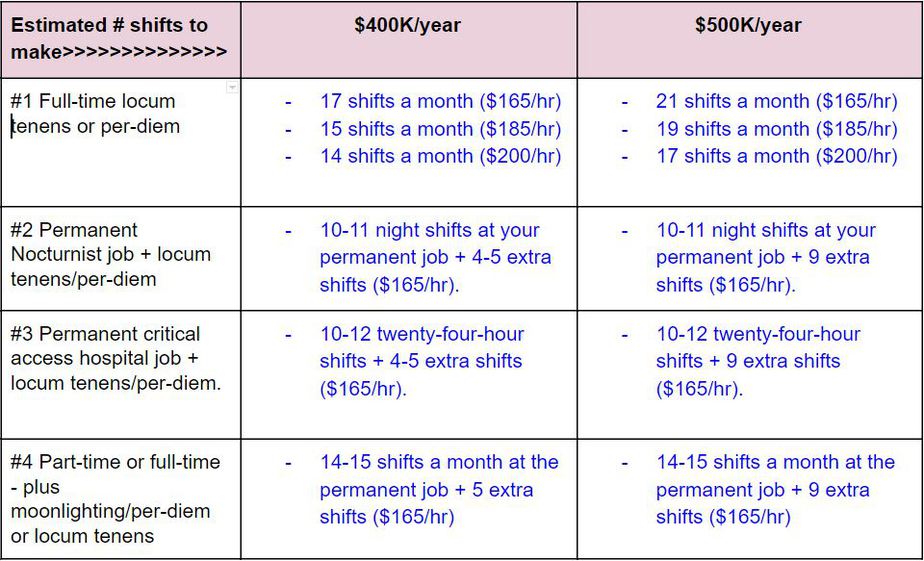
Option #1: Full-time locum tenens or per-diem

  • Estimated # of shifts to make $400K:
  • - 17 shifts a month with $165/hr
  • - 15 shifts a month with $185/hr
  • - 14 shifts a month with $200/hr

Benefits:  you pay for your own benefits.

Note:  great for hospitalists who don’t mind being away from home for at least one week a month.

This is what I’ve done for years. I started as a full-time locum after two and a half years of a permanent job, and later on, I added per-diem shifts to the mix. 

Even with the most basic $165/hr rate, you can totally achieve this; after all, anybody can work 2-3 extra shifts a month.

With this approach, the biggest challenge is that you may need to travel. So, if you absolutely have to stay within commutable distance from your home (family, small kids, etc.) and you are NOT in a big metro area that has lots of big hospital employers offering per-diem jobs, you will be better off looking at other options.

But…if you CAN travel for at least 7-10 days a month, this is totally doable. Plus, travel can be a lot of fun: you’ll explore exciting places and meet a lot of new people.

  • Jumpstart your Locums Career!
  • Sign up for my coaching to access:
  • Top Gigs
  • Top Pay
  • Unique resources
  • No stress
Learn more
  • Jumpstart your Locums Career!
  • Sign up for my coaching to access:
  • Top Gigs
  • Top Pay
  • Unique resources
  • No stress
Learn more

Onward.

Option #2: Permanent nocturnist job + locum tenens/per-diem

  • Estimated # of shifts to make $400K:
  • 10-11 night shifts at your permanent job and 4-5 extra shifts ($165/hr).

Benefits:  covered by the employer.

Note:  the best option if you don’t mind working nights.

I am not talking about 7 on/7off nocturnist jobs here: this schedule is hard and most people burn out. 

I am talking about 7 on/14 off jobs. 

You may be surprised, but there are a lot of hospitalist programs that try hard to retain their night docs by offering a 17-19 weeks a year schedule with the same full-time pay. 

With this schedule, you’ll have plenty of time off to take extra shifts: you can work extra at the same hospital as your permanent job, sign up for per-diem shifts locally or do locum tenens anywhere else in the country.

I think this is totally the best option for “night owls” since you can make great money and you’ve got more than enough time off left to enjoy life.

On top of that, your permanent nocturnist job will sponsor your benefits and health insurance which will save you some money too compared to full-time locums/per-diem.

Hate nights?

Let’s look at other options.

Option #3: Permanent critical access hospital job + locum tenens/per-diem

  • Estimated # of shifts to make $400K:
  • 10-12 twenty-four-hour shifts and 4-5 extra shifts ($165/hr).

Benefits:  covered by the employer.

Note:  great for hospitalists enjoying autonomy and willing to live in a small town.

A lot of critical access hospitals (i.e., small rural facilities) cannot justify having a “full-blown” nocturnist program. As a result, hospitalists work 24-hour shifts.

I’ve seen anywhere from 10 to 12 shifts a month to be counted as a full time.

Since you work in a smaller hospital and you are the ONLY hospitalist on, your job will look different from your typical gigs:

  • The average patient census is lower and sometimes can be as low as 6-8 patients a day.

     

  • But…it will fluctuate a lot and it’s not uncommon to see a sudden census jump of 50-100% (i.e., from 8-10 to 16-18 pts). This mostly happens during the busy winter season.


  • You are responsible for all medical admits that come to the hospital, so you will round AND admit throughout your shifts.


  • You are guaranteed to get paged at night either from RNs or from the ER to admit patients.


  • Since you don’t have all the subspecialties available, you tend to have a lot of transfers to bigger hospitals, which may get tricky.

On the plus side, you’ve got much more autonomy in making decisions, and patients tend to be more grateful for what you do.

Onward.

Option #4: Part-time or Full-Time — plus moonlighting/per-diem or locum tenens

  • Estimated # of shifts to make $400K:
  • 14-15 shifts a month at the permanent job and 5 extra shifts ($165/hr)

Benefits:  covered by the employer.

Note:  part-time option is great for “cautious” docs willing to get benefits AND get exposed to the locum’s world.

This approach may be the most common one that I see hospitalists are doing. You’ve got your full-time job and you work on the side for an extra income.

The thing is, if your permanent job pays peanuts or gives you less money just ‘cause you are a new grad, you may end up working a lot of extra shifts to get to our “magic” number.

On the other hand, if you are NOT interested in traveling, checking different places, working locum tenens AND you find a job that pays $300K+ a year for fresh grads, be my guest! 

Just make sure your permanent job can supply you with enough extra shifts in-house.

If not, it may be hard to find a locum gig on the side, as a lot of hospitals want you to commit to at least seven shifts a month. So you’ll end up either getting stuck with your base salary or you’ll get overstretched with working 20+ shifts a month.

That’s why I like the idea of signing up as a part-timer (7-10 shifts a month) and working locum tenens or per-diem in your time off. 

You kill two birds with one stone:  you have a stable job that covers your benefits AND you can easily find shifts on the side.

What it takes to make $500k your first year as a hospitalist?

Half a rock without a shock!?

What if half a million sounds better to you AND you are ready to churn out in a total “beast” mode?

Great, I’ve got a breakdown for you in the table below.

  • Click the image to zoom

Word of caution:

I suspect a lot of you reading this article may be tempted to work a GAZILLION shifts per month as soon as you graduate. After all, you really want to build a solid financial base ASAP.

Just remember: your career is a marathon not a sprint…

So give yourself plenty of time to rest, don’t forget to learn something new every year, pick up a hobby or two and spend time with your friends and family.

Balance is the key!

Physician Assistant Locum tenens

Physician Assistant Locum Tenens: Salary, Agencies, Checklists

Finding best locum tenens companies in 2026

pro and cons locum tenens

Pros and Cons of locum tenens: Doctor’s perspective

Locum tenens guide

Locum Tenens Guide 2026: Locum Tenens Meaning, Taxes, Insurance & More!

Locum Tenens Oncology

Locum Tenens Oncology Guide: pay rates, schedule, tips for success

Locum Tenens Neurology Guide: pay rates, schedule, hours, pros and cons.

As featured on

logo_doximity
New to locum tenens? Check out my complete guide for newbies in 2021!

Filed Under: insurance

  • « Go to Previous Page
  • Go to page 1
  • Go to page 2
  • Go to page 3
  • Go to page 4
  • Go to page 5
  • Go to page 6
  • Go to Next Page »

Primary Sidebar

x